The Alphabet Versus The Goddess

Painting by Rose Datoc Dall.
Long before I discovered seminary and the world of theological nerdery, I had the 200s section (religion and philosophy!) of the Denver Public Library. On summer breaks in college I would bike down to the central branch at 13th and Broadway and spend hours browsing the shelves, piling books into my basket, and finding a cozy corner to spread out.
I skipped over many books I would later come to love in grad school and went straight for the juicier spiritual reads. One such book was called “The Alphabet Versus the Goddess” because who can resist a title like that?
The main idea is that when civilizations begin to use written alphabets, they lose a crucial connection connection to icons and images.
Why is it important to stay connected to images?
Well the author claimed that in civilizations that communicate through art or glyphs, people used their creative right brain more creating a cultural reverence for the divine feminine and balance between the sexes. In alphabet-based civilizations, people used their linear left brain and those civilizations became more controlling and masculine.
Now, as many reviewers have said since the book was published, the research is thin and the premise is shaky. It’s more of an intriguing idea than something actually based in reality.
Civilizations are complex, brains even more so, and as scientists love to point out, correlation is not the same as causation
But as a young woman just beginning to explore theology, the idea was thrilling.
I loved to think that spiritual experience could be influenced by how we communicate. And because this book talked about communicating in images, I began what is now a 20-year journey into theological pictures and art.
What I discovered is that my understanding, experience, and concept of the divine are very much influenced by how the holy is artistically depicted.
(Insider secret, I’m often trying to say as much with the images I choose for this newsletter as I do with my words. But you’ve probably noticed that already.)

“Garden of Kama” By Byam Shaw
Of all the theological formations I’ve had through art, the depictions of Mother Mary have been the most powerful.
The most common modern image of Mary is a sweet, almost childlike, face wrapped in a blue robe, eyes demurely downcast as she receives the blessing of the Lord.
When I was young this depiction felt equal parts boring and deeply offensive so I never paid it much mind. But in the years since, I’ve come to see this holy powerhouse of a woman depicted in so many ways that I’ve had to reevaluate my assumptions. Which is, of course, a common occurence in my life.
And Mary has waited patiently for me this whole time.
As regular readers will know, I’m somewhat obsessed with Jesus. But something about the absolute and overwhelming inundation of images the past few years has begun to shift my perception of the divine.
In other words, thanks to the memes, videos, artwork, and pictures Pictures PICTURES all over every form of communication and social media I use these days, the Goddess has somehow rearisen within me.
In the supposed battle between the Alphabet (of which I am a huge fan) and the Goddess, She seems to be winning again. At least within my own spirit.
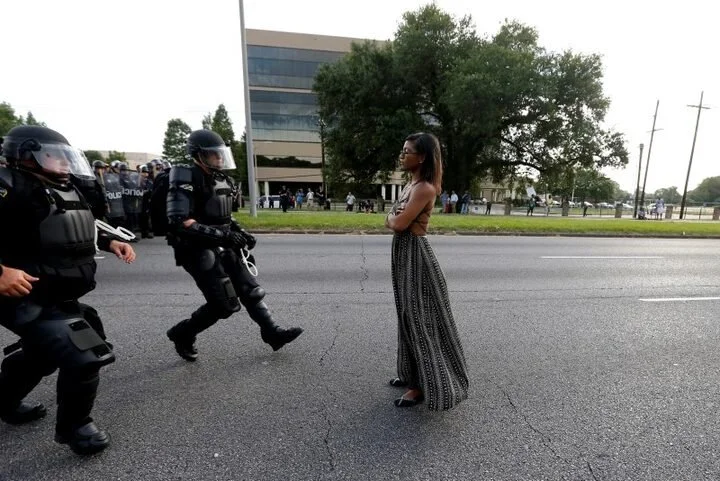
Protestor Iesha Evans at a 2016 Baton Rouge, LA protest, photo by Jonathan Bachman.
And I also wonder at the immese upheaval happening across the world; is it the Goddess returning?
This thought became conscious in the summer of 2016 when I saw a picture of a young woman at a Black Lives Matter protest facing off with the police.
The caption on the article I read was ‘The Future is Female’ and seeing this photo I couldn’t help but believe it, or desperately hope for it at least. I’ve since printed this picture and taped in a few different notebooks of mine, and it’s part of my almost embarrasingly large collection of online images of the holy feminine, of which Mary is now certainly a part.
In fact, images of Mary will be a huge part of my 2025 Online Advent Course.
Part of the reason I’m even teaching this course is to have other folks who want to gush over this incredible art as much as I do. Already, folks have been sending me new depictions of Mary that yet again change and deepen my understanding of who she was and is.
Whatever your relationship to Her, I do hope you’ll join us for this online Advent journey. May it help even in some small way to bring about a world where She reigns with elegant mercy, swift justice, and the rich divine love we’re all so sorely needing right now.
I’ll see you there!
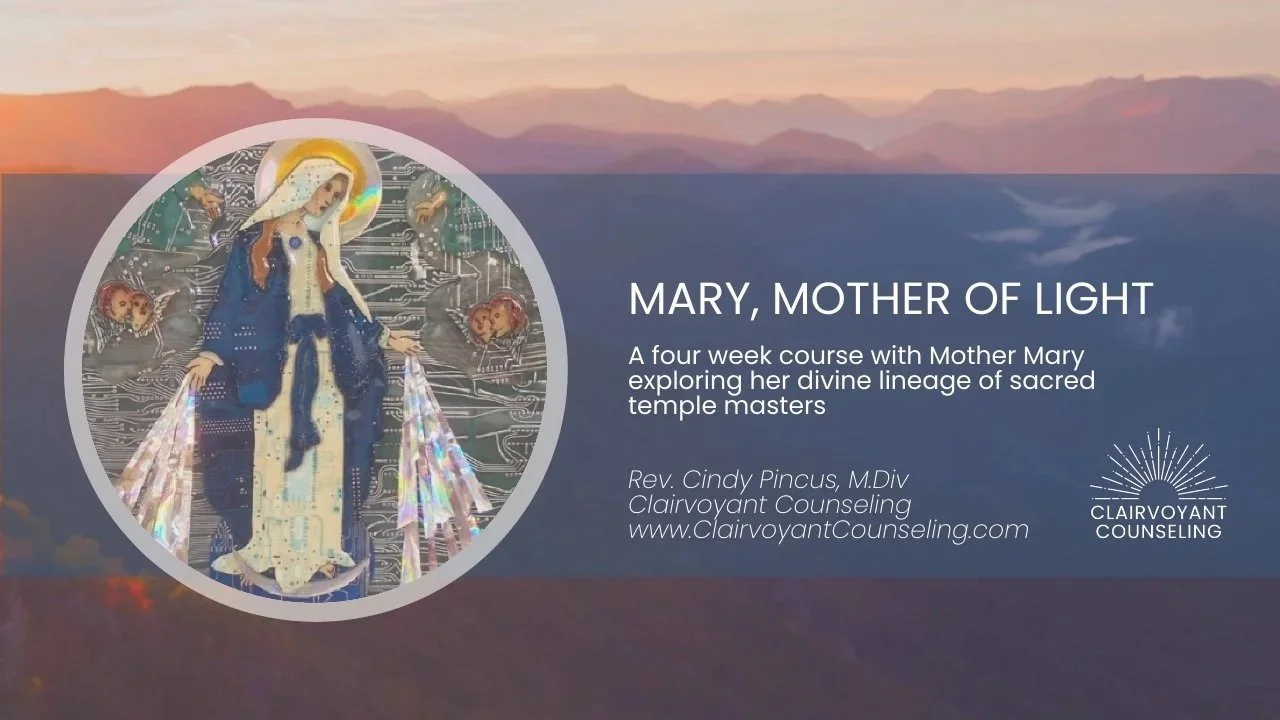
ADVENT 2025 - MARY, MOTHER OF LIGHT
Digital Advent with Mother Mary
Mary is so often depicted as a simple virgin who is totally surprised by the angel’s visit informing her she’s pregnant. But what if she’s actually something completely different…
WHO IS THIS COURSE FOR?
⫸ Ministers, healers, and teachers who want to integrate Mary’s mysticsim into their own work
⫸ Interfaith seekers who honor Jesus and Mary as archetypes of awakening
⫸ Those with a personal connection to Mother Mary wishing to explore her practices of spiritual mastery
⫸ Artists, poets, and all creatives who want to conect with Mary’s divine image (lots of art included!)
⫸ Students of apocryphal texts curious about the hidden gospels and early Christian mysticism
⫸ Anyone seeking a contemplative and heart-centered way through the Advent season
⫸ Spiritual practitioners interested in manifesting, divine feminine embodiment, and sacred consciousness
EARLY BIRD ENROLLMENT IS $99 THROUGH OCTOBER 31ST!
Regular enrollment is Nov. 1st-30th - $129
Enjoyed the newsletter? Please take 5 seconds to forward it to someone who would benefit. I put hours into each one and my favorite folks come via word of mouth. It’s the easiest way to support my work!
New Here? If you have been forwarded this newsletter subscribe here. You can find lots more on my Instagram, all past newsletters on my Blog, and lots of services on my website included Clairvoyant Counseling, Courses, and Teachings.
Artwork? Top image is by Rose Datoc Dall. Second image is “Garden of Kama” by Byam Shaw. Third image is a photo of protestor Iesha Evans by Jonathan Bachman.
Found a missing link? I’m basically running this whole operation solo so if you find a typo or mistake, please let me know! I so appreciate it.